
The month has ended. The sales were great and the P&L had a profit, and there was no sign of anything to be terribly off.
Verify the restaurant’s bank account.
The number you received wasn’t what you expected.
For owners of restaurants, this disconnection can be a source of frustration because the cash flow and profit feel as though they should tell the same story. They don’t. A P&L measures the financial performance of a company over a specified period of time, while it is a bank account that shows the exact time of money entering and leaving the company.
Understanding the difference can alter the way a restaurant’s manager thinks about their finances.
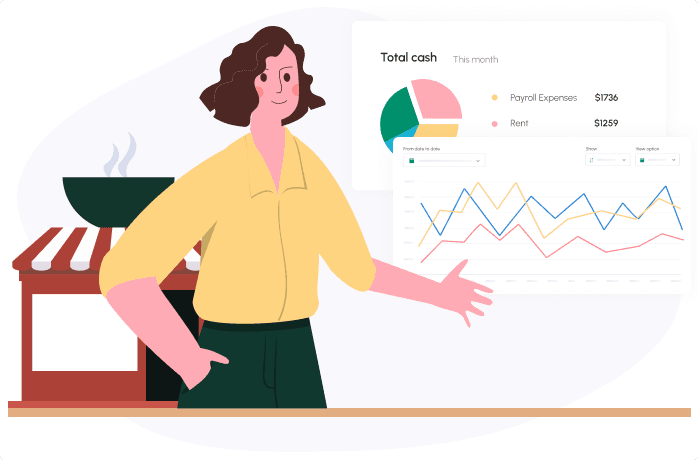
Imagine what happens on a typical week. Customers pay for meals. Employees have to be paid. The invoices for food and beverages are delivered. Rent is coming. Credit card payments are timed. Sales tax is collected, but that money has a responsibility.
On the other hand, the next week’s shopping has already started.
Looking only at revenue or the end-of-year profit number does not take into account a lot of the activity.
The answer could be hidden in the prime cost
Food, beverage and labour cost are all worth a close at when profitability in restaurants begins to fall.
Together, cost of items sold and labor make up prime cost. The Bookkeeping Chefs’ instructions place the main cost between 60-65% of revenues for many establishments. They also recommend the importance of weekly monitoring rather than waiting until the end of the month.
Effective prime cost management involves less focusing on a single percent, and more paying attention to early changes.
Imagine that the restaurant usually performs close to its target, but this week’s percentage rises. Perhaps overtime has is up. The beverage cost may have remained the same while food prices increased. An increase in the percentage of food consumed could lead the business owner to look at buying, waste management portions and menus, or vendor costs.
The percentage is the most important. The answer is found in the restaurant’s activity.
Weekly reports make that conversation possible while everyone still remembers what happened.
After two or three weeks, it gets more difficult to reconstruct the specifics.
The Vendor’s Bills Are Received
A restaurant could purchase the ingredients this week but pay for the ingredients in the future. This explains the reasons why profit alone isn’t enough to answer all cash-related questions.
Vendor invoices have to be received, recorded as well as tracked until they are paid. In a business that has numerous suppliers, doing that manually can turn into an administrative task.
Automating the process of paying bills can assist in coordinating this process by reducing the repeated handling of bills and payments. Bookkeeping systems that are integrated can give owners a better understanding of their obligations, even if they have not yet been paid.
It’s beneficial because, when looked at as a whole the balance of a restaurant’s bank account could appear to be more healthy than its actual short-term financial situation.
There is currently $80,000 on the account. The figure of $80,000 is small if the cost of rent, vendors or payroll make up a large portion over the next few days.
That leads naturally to cash flow forecasting.
Instead of asking “How many dollars of cash are we carrying?” the better question is “What will be the fate of our cash following the money we expect to receive and the obligations we are already aware about?”
It is important to know what the distinction is when deciding if this week is an ideal time to replace equipment, purchase more products or save the cash flow.
You may not have been rightfully entitled to all the money you believed.
Sales tax illustrates this particularly well.
The money restaurants receive from their customers is eventually going to need to be handled in line with its tax obligations. If these dollars are mentally coupled with the normal cash flow, the balance in a bank can offer a false impression of how much cash is available.
A consistent record-keeping system helps restaurants to comply with the sales tax laws as well as providing an accurate overview of their financial standing.
This is the reason restaurant accounting works better when financial responsibilities aren’t considered as distinct islands.
Prime cost affects margin. COGS and future payments are affected by vendor purchases. The percentage of labor and cash are affected by payroll. Cash flow is impacted by the sales tax. P&Ls report financial performance, and forecasting lets management look ahead.
Connect the pieces.
Bookkeeping Chef utilizes restaurant-specific reporting as well as system integrations to connect the pieces. Bookkeeping outsourcing can benefit operators who do not want to be tasked with reconciling their financial data.
The last part is important.
Restaurant owners shouldn’t be able to stop studying the literature just because they are handled by someone else. Owners need to be informed that helps them be aware of what’s happening.
If the P&L indicates that the restaurant is profitable however, the balance in the bank feels too tight, don’t think that the P&L may be inaccurate.
Ask about the events that occurred between them.
The answer to this question will give you more insight into the restaurant, more than just the name.