
A manufacturer wins a major contract. Its monthly production needs rise, but the facility hasn’t seen a sudden increase in flooring space, skilled workers or working hours during the daytime. A second shift may help temporarily, but it can be a source of new labor or training, supervision and quality-control regulations.
These situations reveal a very significant reason to use robotics automation. Robotics does not only replace people with machines. It’s a tool that can modify the methods that manufacturers employ to use their current production capacity.
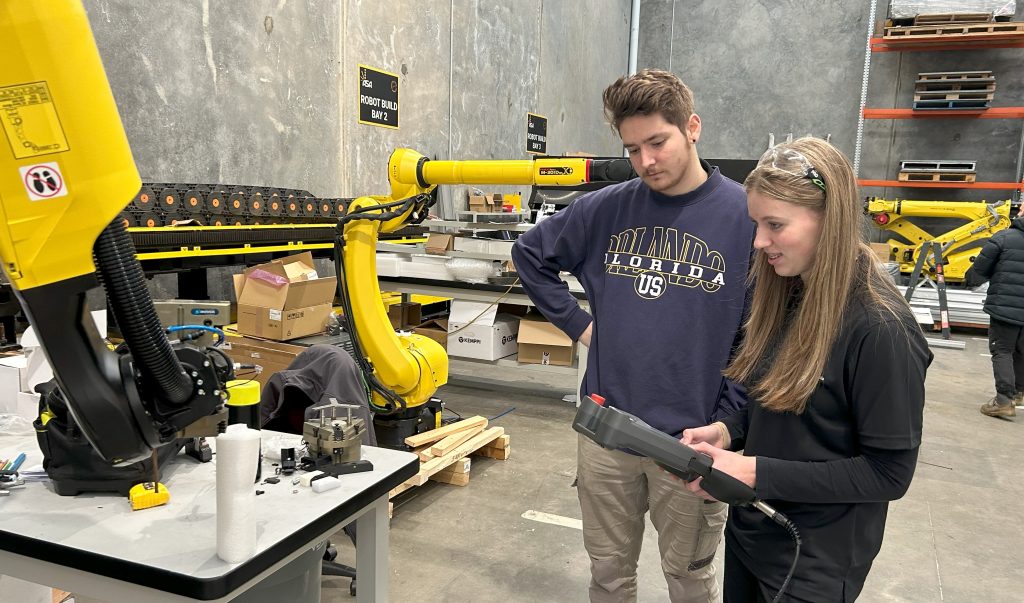
Image credit: automatedsolutions.com.au
Take a look at the seconds that disappear between products
Manufacturing inefficiency doesn’t have to be noticeable. An operator could spend 15 minutes putting the part in place after which 10 seconds are spent applying substances, and then a few seconds to move it to the next step. On one component the difference appears to be insignificant. If repeated thousands of times, these seconds can turn into an enormous amount of production time.
This is also true of wasted material. This is also true for waste material.
Companies considering robotic automation Australia projects can benefit from examining these small, repeated losses before deciding what equipment they need. ASA’s analysis of needs is designed to pinpoint bottlenecks and quality issues as along with waste and other constraints during a project.
The robot should fit the processes around it.
A robot is one of many engineering choices. The system might also require guarding, tools and controls, sensors conveyors, fixtures electrical integration, and communications with existing production equipment. Engineers must take into consideration reach and payload while also making decisions about how the robot will move through its workspace and interact with the environment around it.
ASA provides the ability to develop concepts, system design and offline programming in its approach to robotic automation. The digital simulation allows engineers explore configurations, estimate cycle times and test the system before it is operating on the floor of a customer’s premises. It’s particularly useful when there is a small amount of space, or when the new robotics needs to integrate with a production line.
The importance of repeatability in painting and dispensing
Certain manufacturing processes highlight the importance of controlling movements. Imagine coating hundreds, or thousands of components. The goal isn’t just completing each component quickly. From the beginning of production all the way to the finish moving, speed as well as the distance to be applied must be controlled.
ASA is a team of experts working on dispensing and paint applications across all industries, including aeronautics and automotive. Industrial robotic automation in these environments allows for reproducible movements while limiting exposure of employees to physically demanding procedures or ones that may be dangerous.
A better control of materials that are discarded can contribute to productivity improvements by cutting down on the amount of waste material consumed.
The installation of the system isn’t enough. It is still necessary to have people to manage it.
Automatism isn’t a substitute for manufacturing knowledge. It alters the knowledge required to manage and maintain the process.
Employees should be able to recognize unusual behavior and resolve issues, and perform the appropriate maintenance. Production requirements may also alter, indicating that processes and programs may require modifications later.
ASA offers training on-site in programming, safety troubleshooting, and mechanical and electrical maintenance. It also offers servicing and support on a regular basis to assess the condition of the equipment and deal with problems that arise over the system’s operational duration.
Capacity is greater than working more quickly
For Australian manufacturers, increasing capacity doesn’t necessarily mean purchasing a larger building or continually adding more workers to repetitive processes. The more important question to consider is whether the current manufacturing process can be improved.
ASA has been working on and integrating automation solutions in Australia since 2002. We also help with projects in other countries. The approach combines needs analysis, engineering, simulation, FANUC robot integration, training, and servicing.
Automation is not the only goal. A system worth investing in should offer a manufacturer measurable results, like more reliable production, higher quality, safer procedures with less waste, or a greater capacity.